




Almost everything written about Incoterms assumes you’re moving a full container. If you’re buying a few hundred pieces at a time, which is where most independent retailers and online sellers actually operate, a lot of that advice quietly stops applying.
We manufacture shapewear in Shenzhen and ship on both sides of that line. Here’s the short version, and then why it works that way.
If your order is under about 100 kg, the shipping term barely matters. You’re on a courier, and the only thing that changes your freight bill is the size of the box. From a few hundred pieces up, the term is worth real negotiation, because ocean freight becomes available and the cost gap between terms turns into margin.
The terms themselves, briefly
EXW means the goods are ready at our factory and everything after that is yours. FOB means we cover the China side, trucking to port, export declaration and loading, and you take over once the goods are aboard. CFR adds the ocean freight to your port and CIF adds insurance on top, with import clearance still yours under both. DDP means we deliver to your door with clearance and duty handled.
We’ve written up what each one includes and excludes, and which our buyers typically choose, in Nanbin shipping options: EXW, FOB and DDP explained. This article is about something that guide doesn’t cover: how the freight bill is actually calculated below a container, and why the term you pick barely moves it at small volumes.
One warning before moving on, because it’s the most common way first-time importers lose money: an EXW quote looks cheapest and usually isn’t. Add factory pickup, export declaration and origin charges back in and the gap against FOB narrows or reverses.
Weight picks the channel, and the channel picks the term
You don’t choose a term and then find a way to ship. It runs the other way.
If your order fits in a carton and goes by DHL or FedEx, there is no vessel to be free on board of. FOB is meaningless. The courier collects, clears export, flies it, clears import and delivers. Whether the invoice says DDP or says nothing, the experience is the same.
The dividing line is 100 kg, because that’s the minimum for traditional ocean freight. Below it, ocean isn’t available at any price, and your realistic options are courier (fastest, most expensive per kilo, clears both ends for you) or air freight (airport to airport, you collect and clear yourself). Above it, ocean opens up and per-kilo cost drops sharply, with sea express as the door-to-door version if you’d rather not deal with a port.
So the first question isn’t “EXW, FOB or DDP.” It’s what the order weighs.
Why your freight bill won’t match your bathroom scale
Couriers don’t bill what the box weighs. They bill chargeable weight: the higher of actual weight and volumetric weight, where
volumetric weight (kg) = length × width × height in cm ÷ 5000
DHL, FedEx and UPS all use 5000 for international shipments, then round the result up.
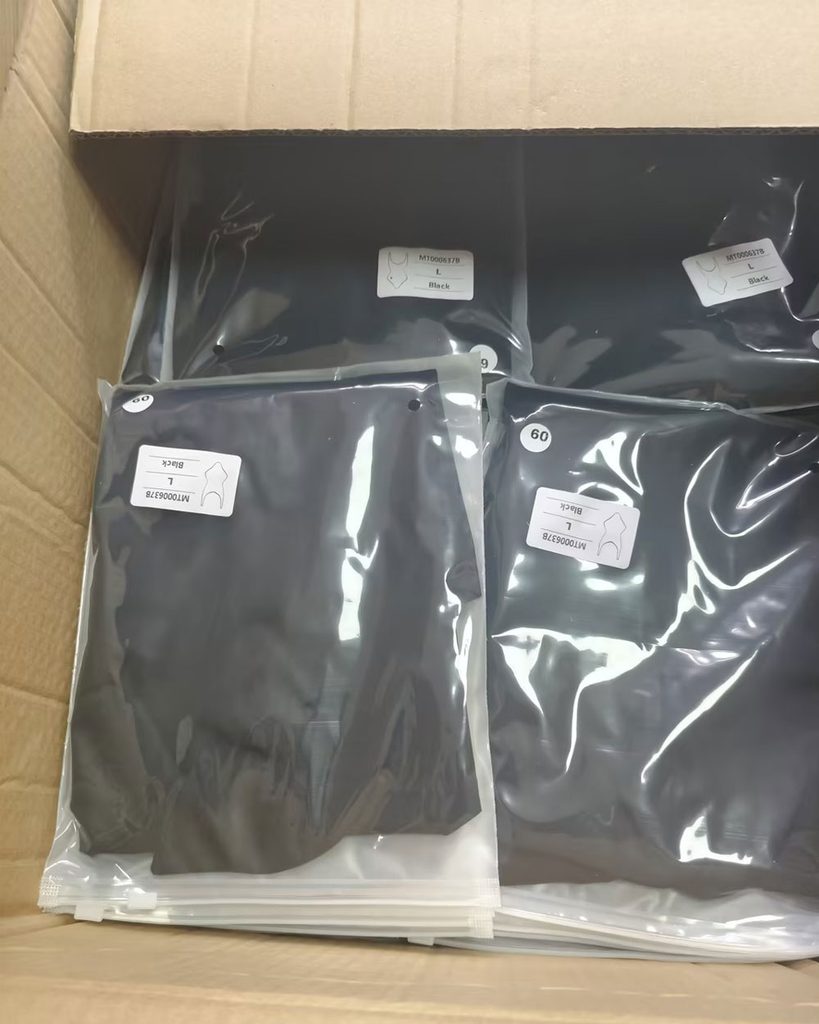
Our standard export carton is 51 × 36 × 31 cm, which works out to about 11.4 kg of volumetric weight. The part that catches people out: that number has nothing to do with what’s inside. An empty carton and a full one have the same volumetric weight, because it measures the space the box takes on the aircraft, not its mass.
So if your goods plus the carton come to less than 11.4 kg, you’re billed 11.4 kg anyway. Everything under that line is empty space at courier rates. This is why we drop to a smaller carton, or cut a standard one down, when an order doesn’t fill one.
Ocean freight ignores all of this and bills by volume instead: our standard carton is 0.0569 m³, so sixty of them is 3.4 CBM, and that’s what you’re quoted on.
Neither method is wrong. They belong to different channels, and applying one to the other is where most freight surprises come from.
Where your order actually sits
Take shapewear bodysuits at roughly 200 g a piece, typical for a mid-weight style.
Under about a hundred pieces, you’re at 20 kg or less and you’re on a courier whether you like it or not. Choosing a term here is a formality. The only lever that saves money is box size.
Between roughly two hundred and five hundred pieces is where it gets interesting, and where most of our regular buyers sit. Somewhere in this range you cross the 100 kg floor and ocean becomes available for the first time. Per-piece freight can fall by an order of magnitude against courier rates, and it falls at the same time your unit price does. Two savings arriving together is what makes this bracket worth planning toward rather than drifting into: four courier parcels spread over two months cost considerably more than the same goods consolidated into one shipment.
This is also where the term stops being trivia. Buying wholesale shapewear in bulk on FOB means we deliver to the vessel and you take over. On sea express it arrives at your door, cleared. The gap between those two numbers is real money at this volume.
Above five hundred pieces the same logic compounds, and by then you’ll want your own forwarder relationship rather than ours.
What “transit time” does and doesn’t cover
When a carrier publishes three days to the US, that covers the transport leg only. Your order has four:
- Picking and packing. For in-stock styles, we dispatch within 3 days of order confirmation.
- Handover. Documents, declaration, collection.
- Transport. The published number. Identical for every shipper on that service, and it slips around public holidays and weekends at either end.
- Import clearance. Depends on your country and whether the paperwork is clean. Nobody can promise this one.
We don’t publish our own transit times, because we’d just be repeating the carrier’s and theirs is authoritative. What we commit to is step one.
FAQ
Does volumetric weight include the carton?
No. It comes only from the outside dimensions of the box, so it’s identical whether the box is full or empty. Your actual weight (goods plus carton) is measured separately, and you’re billed on whichever is higher.
Which term should I ask for on a first order?
Under about 100 kg, don’t ask for a term at all. Ask what it costs delivered to your door with duty included, and compare that one number across suppliers. Then ask for a second quote at the volume you’re working toward, so you can see where the freight curve breaks.
Do you handle customs clearance?
Export clearance in China, always. Import clearance at your end only under door-to-door terms. Under FOB, CFR or CIF you clear at your own port, and we make sure your documents are correct and complete.
How long before my order ships? In-stock styles dispatch within 3 days of order confirmation. Bulk production runs about 25 days. Transit time on top of that is the carrier’s published figure for your destination.
Where do you ship?
The United States, United Kingdom, Europe, the Middle East, Southeast Asia and Africa.
Is EXW cheaper?
On paper. Add pickup, export declaration and origin charges and it usually isn’t.