

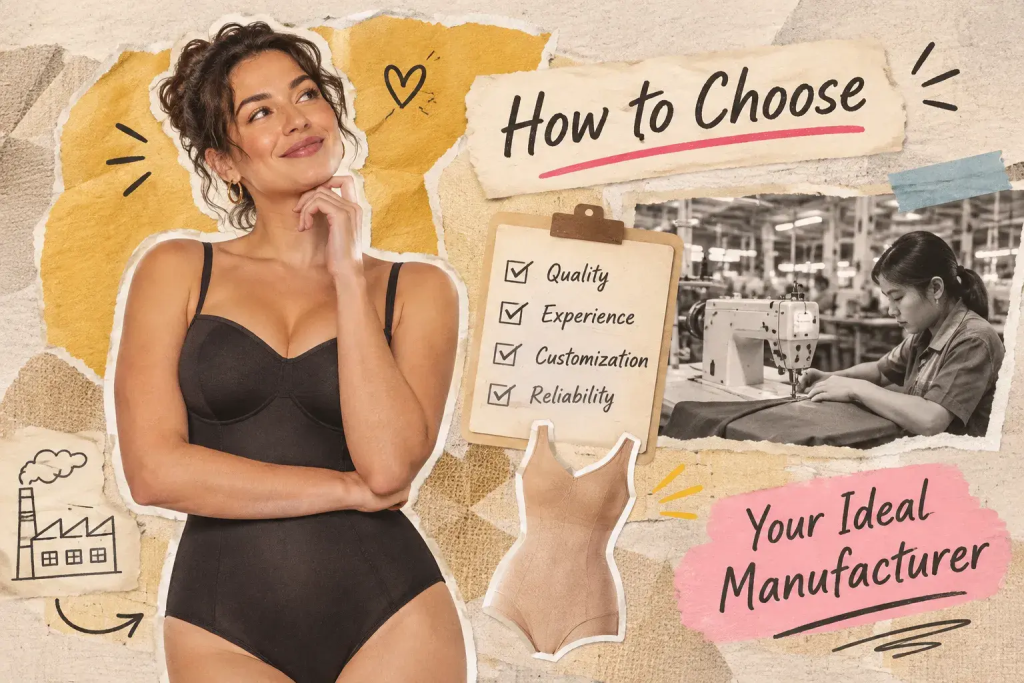
When comparing private label shapewear manufacturers, look for a partner that matches your sourcing tier (blank in-stock, private label, or full OEM), publishes clear MOQs, proves fit with real samples, documents its QC, and ships to the U.S. on a predictable timeline. Check those five things before you pay for anything.
This guide covers those five checks, plus the questions to ask before you commit. It’s written for new brands, Amazon FBA and TikTok Shop sellers, wholesalers, and brands switching factories. Use it as a checklist when you compare quotes.
We’re Nanbin (Shaper Factory), a shapewear factory in Quanzhou, China, operating since 2015 with 400+ staff. We handle everything from material sourcing to finished garments in-house, and we cover every tier compared below.
Key takeaways
- Match your tier: In-stock suits testing demand, private label (ODM) suits fast launches, and full OEM suits exclusive products.
- Clarify MOQs: Ask whether the minimum applies per style, per color, or per order.
- Test real samples: Compression comes from design, so measure samples on several body types and after washing.
- Verify documents: Ask for current certificates, a QC process with an AQL level, and a production report.
- Quote everything: Confirm whether packaging and freight are included before you compare prices.
Which type of private label shapewear manufacturer fits your brand: in-stock, private label, or full OEM?
Pick the tier that matches how much design risk you want to carry. In-stock is the fastest and lowest-risk, private label (ODM) sits in the middle, and full OEM gives you the most control at the highest cost and slowest speed.
Blank in-stock and heat-transfer logo styles
This is the fastest entry point, and it suits wholesalers, FBA sellers, and anyone testing demand. You buy existing styles, blank or with a heat-transfer logo, and skip development entirely. Our in-stock catalog ships mixed colors and sizes within 1-3 working days.
Private label (ODM) with your labels and packaging
You start from the factory’s existing patterns and change colors, fabrics, logos, hangtags, and packaging. It launches faster and costs less than building from scratch. The catch is exclusivity: similar designs may be available to other buyers unless you negotiate otherwise.
Full OEM development from a tech pack
You supply the design, measurements, compression map, and fabric spec. It’s slower and costlier, but it can give you an exclusive product and stronger IP control. Neither is automatic: exclusivity and design ownership depend on your contract. Terminology also varies, and some factories swap the OEM and ODM labels, so agree on ownership and exclusivity in writing before development starts.
Side-by-side comparison
The MOQs below are typical industry estimates and vary by factory, style, and level of customization.
| Criteria | Blank in-stock / heat-transfer logo | Private label (ODM) | Full OEM |
|---|---|---|---|
| Design source | Factory catalog | Factory patterns, your branding | Your tech pack |
| Typical MOQ (estimate) | About 50-300 pieces per style with a logo | About 100-500 pieces | 1,000-3,000 or more is common |
| Customization depth | Low (logo) | Medium (colors, fabrics, labels, packaging) | Highest |
| Speed | Fastest | Fast | Slowest |
| Cost level | Lowest | Moderate | Highest |
| Exclusivity | None | Negotiable | Can be strongest, depending on contract |
| Best fit | Wholesalers, FBA sellers, demand testing | Startups and private label sellers | Established brands with specs |
Nanbin offers all three tiers, so you can start with in-stock styles and move up to private label or OEM as your brand grows, without changing factories.
What do minimum orders, samples, and delivery timelines really look like?
Expect minimums from about 50 pieces per style for catalog styles up to 1,000-3,000 or more for fully custom work. Sampling an existing style can take days, custom development takes longer, and a first order of an existing style typically lands in 3-6 weeks by air. These are estimates that vary by supplier.
MOQs and what drives them
Typical ranges are 50-300 pieces per style for catalog styles with a logo and 100-500 for custom branding and packaging. Fully custom development commonly requires 1,000-3,000 or more, though some suppliers advertise 50-piece programs. Ask whether the MOQ is per style, per color, or per order, because factories calculate it differently.
Low minimum order shapewear manufacturers with mix-and-match sizes cut risk for startups. You can test several styles and sizes without sitting on dead inventory.
How sample fees work
Fees differ by sample type: an unmodified stock sample, a logo or color-change sample, and a full development sample. They’re often credited back to the order, but not automatically, so get the terms in writing. Our samples take 7-14 working days, and the sample fee is credited back once the order reaches MOQ or 200+ pieces.
Hidden costs to budget for
The unit price is rarely the whole bill. Budget for freight, duties, custom molds or hardware, packaging, and size and color assortments. Ask every supplier whether the quote includes packaging and shipping, or you’ll compare unlike numbers.
Timelines from sample to U.S. doorstep
Industry sources describe roughly 2-10 working days for samples of existing styles and about 7-14 days for custom development. Revisions add time, and transit is extra. Production takes roughly 7-20 working days for private label and 25-45 days for full OEM. Air express adds about 3-10 days; sea freight adds about 25-45 days.
For planning, allow 3-6 weeks for an existing style with a logo by air, and 8-14 weeks for a fully custom order by sea. Custom dyeing, new patterns, multiple fit rounds, holidays, and customs clearance all stretch the schedule.
How do you judge fit, compression, and customization before you order?
Judge them on physical samples, not spec sheets. Compression is the combined result of fabric elasticity, recovery, panel placement, seams, and garment measurements, so a fabric label alone tells you little.
Compression is a design result, not a fabric label
Ask how the factory maps zones (waist, abdomen, back, hips, thighs) and how it prevents rolling. If you’re comparing seamless shapewear suppliers, ask about their knitting and CAD capabilities. We build seamless shapewear with in-house needle and CAD programming and body-mapped compression zones. That engineering is backed by 100+ registered design patents.
Sizing and fit range
Ask for the size chart, grading rules, and plus-size patterns, not just a list of sizes. We cover extended sizing up to 4XL/6XL, which matters for FBA and TikTok Shop sellers. Test the sample on multiple body types and measure again after washing.
What you can customize
Custom shapewear manufacturers typically offer these options:
- Fabrics: nylon/elastane, powernet, mesh, bamboo, recycled blends
- Colors: standard colorways or Pantone matching
- Branding: labels, heat-transfer logos, hangtags
- Packaging: polybags, boxes, inserts
Custom colors, fabrics, and retail packaging usually carry higher MOQs or fees than a logo on a stock style. Ask for those costs up front.
How can you verify quality control and compliance?
Ask for documented inspection at three stages and current certificates, then review a pre-production sample and a production report before you pay the balance.
Quality control checkpoints
Look for incoming material, in-process, and final inspection. We run a three-tier system (IQC, IPQC, FQA) with AQL 2.5/1.0 inspection and optional SGS third-party testing.
AQL is the acceptable quality level used with a sampling plan, not a defect allowance. An inspector checks a random sample sized to the lot and compares the findings against set accept and reject numbers. Passing means the sample met the plan, not that every garment is perfect, so specify defect definitions and measurement tolerances.
Certifications that actually mean something
Each certification covers a different risk, and none replaces the others.
- BSCI audit: a social compliance audit of working conditions at the audited facility, not a product safety certificate. Ask to see the current audit report and rating.
- ISO 9001:2015: proof of a documented quality management system, not a guarantee that every garment is flawless.
- OEKO-TEX Standard 100: fabric tested for harmful substances, limited to the products listed in the certificate.
We hold BSCI audit and ISO 9001:2015 certification, and our fabrics are OEKO-TEX Standard 100 certified. Whoever you buy from, ask for the current certificate and check its scope, validity dates, and covered factory location.
U.S. labeling and import basics
Garments sold in the U.S. generally need labels showing fiber content, country of origin, the responsible business (a name or an FTC-assigned RN), and care instructions. The FTC’s textile labeling guidance and the CPSC’s apparel compliance guide spell out the requirements and exceptions, so check them against your products. Duties and customs paperwork come on top. Confirm who prepares the labels and the shipping documents. Also ask about NDAs and how the factory protects your designs.
Which questions should you ask before you commit to a manufacturer?
Ask the ten questions below in your first email. Vague or slow answers tell you as much as the answers themselves.
Ten questions to put in your first email
- What is the MOQ by style and by color?
- Who owns the design, and is it exclusive to us?
- What is the sample fee, and how is it credited?
- Are there development fees?
- How do you test fabric and compression?
- What is your QC process and AQL level?
- Which certificates are current, and can we see them?
- What are the lead times at each stage?
- Does the quote include packaging and freight?
- What are the payment terms?
Red flags to watch for
- Vague MOQs
- No factory audit or certificates
- No sample before bulk production
- Slow or evasive replies
- A trading company posing as a factory
To rule out that last one, ask for a facility video call so you can see the production floor yourself.
Switching suppliers without disrupting your season
Changing factories mid-season is risky unless the new one can match your product. We offer reverse-engineering and supplier transition support to match the fabric, fit, and compression of an existing product line, with minimal supply chain disruption and strong IP protection. Send your current garment, spec sheet, and size chart, then compare the matched sample against the original.
Conclusion: how to choose your manufacturer
Choose a sourcing tier, test MOQs and samples, verify fit, QC, and compliance, and ask the hard questions. The best private label shapewear manufacturers answer all of them in writing and send a real sample to back it up.
Nanbin (Shaper Factory) is a practical option if you want one factory across blank wholesale, private label, and full OEM. We offer 7-14 working day sampling, three-tier QC, and transition support for brands switching factories. Request a sample or send your current product specs, and we’ll help you start a side-by-side comparison.
Frequently Asked Questions
Can I keep the same manufacturer as my brand grows?
Yes, you can start with in-stock styles and move to private label or full OEM without changing factories. We offer all three tiers, so you can choose the level of customization that fits your brand.
Does passing an AQL inspection mean every garment is defect-free?
No, passing an AQL inspection means the sample met the inspection plan, not that every garment is perfect. Specify defect definitions and measurement tolerances so the inspection has clear accept and reject criteria.
How can I tell if a supplier is actually a factory?
Ask for a facility video call so you can see the production floor yourself. A trading company posing as a factory is a red flag when you compare suppliers.